
What Counts as an HOA Record in California? The Full Civil Code Sec. 5200 List
Most California records disputes don't start with a deadline. They start with a definition. An owner asks for "the bank statements," the manager replies that bank statements "aren't association records," and both sides dig in. The answer is almost always in Civil Code Section 5200, the definitions section of the Davis-Stirling Act's record-inspection article. It lists exactly what counts as an "association record," and if a document fits one of its categories, the owner's inspection rights, deadlines, fee limits, and penalty remedies all apply. Below is the complete list, grouped into plain-English categories, paraphrased from the statute. For deadlines, costs, and enforcement, see our main guide to [California HOA records requests under Davis-Stirling](/blog/california-hoa-records-request-davis-stirling).
MyFrontYard · October 29, 2026
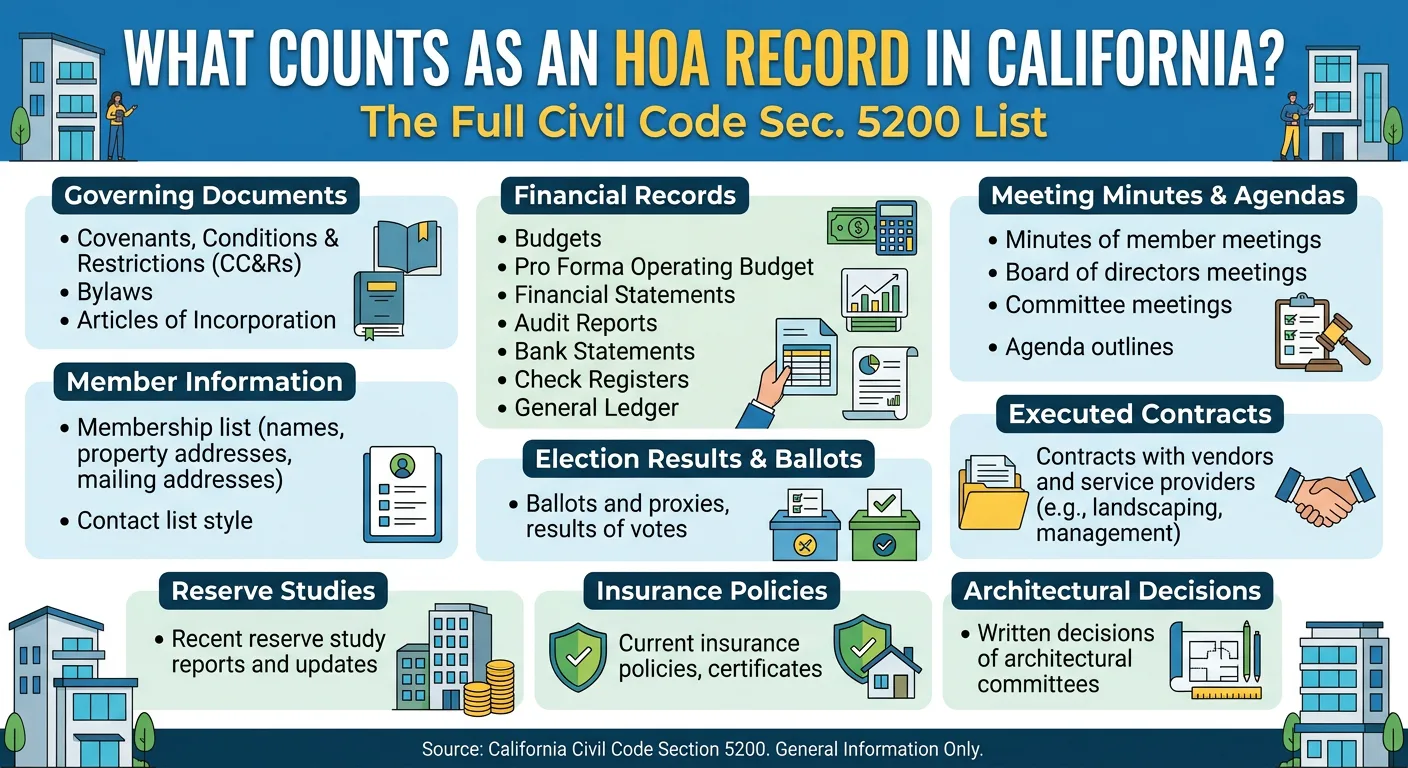
The 15 categories in Section 5200(a)
Section 5200(a) lists fifteen numbered categories. Here they are in order, with notes on what each one covers in practice.
Financial reports and disclosures:
1. Financial documents the Act requires the HOA to distribute to members. This covers the annual budget report and annual policy statement (Article 7, starting at Section 5300), the assessment and reserve funding disclosure summary (Section 5565), and the insurance summary (Section 5810).
2. Financial documents required in resale disclosure. These are the documents an owner must give a prospective buyer under Section 4525: the governing documents, budget, reserve information, assessment details, and similar items.
3. Interim financial statements. Periodic or compiled statements containing any of the following:
- Balance sheet
- Income and expense statement
- Budget comparison
- General ledger, which the statute defines as a report showing every transaction in an association account over a set period
The statute also requires these to be prepared on an accrual or modified accrual basis. A cash-basis summary doesn't fully satisfy this category.
4. State and federal tax returns.
5. Reserve account balances and records of payments made from reserve accounts.
6. Check registers.
7. The litigation accounting under Section 5520(b). When a board uses reserve funds (or temporarily transfers them) to pay for litigation, Section 5520 requires an accounting of those expenses at least quarterly, available for member inspection.
Contracts and spending approvals:
8. Executed contracts, unless privileged under law. This means signed management, landscaping, insurance broker, construction, and vendor agreements.
9. Written board approval of vendor or contractor proposals or invoices. This category matters more than it looks. If a board approves a bid by email or in a signed memo, that written approval is itself an association record.
Governance records:
10. Agendas and minutes of member meetings, board meetings, and board committees created under Corporations Code Section 7212. Executive session minutes and information are excluded from this category.
11. Membership lists: names, property addresses, mailing addresses, and email addresses. Members who have opted out under Section 5220 are left off. (Requesting the list also requires a stated purpose under Section 5225.)
12. The governing documents: CC&Rs, bylaws, articles of incorporation, and operating rules.
Special categories:
13. Enhanced association records (defined in 5200(b), below).
14. Association election materials (defined in 5200(c), below).
15. Inspector's reports prepared under Section 5551, the balcony and elevated-element inspection law for associations with multifamily buildings.
Enhanced association records: Section 5200(b):
"Enhanced" records are the backup documents behind the financials. Owners often don't know they can see them, and boards sometimes assume they're off-limits. Paraphrased, the category includes:
- Invoices, receipts, and canceled checks for payments the association made
- Purchase orders the association approved
- Bank statements for accounts where assessments are deposited or withdrawn
- Credit card statements for cards issued in the association's name
- Statements for services rendered
- Reimbursement requests submitted to the association
Two practical points. First, the bank-statement language is tied to accounts that handle assessments, which covers the operating and reserve accounts for nearly every HOA. Second, enhanced records are the one category where the association may charge for redaction time: up to $10 per hour, capped at $200 per written request (Section 5205).
Association election materials: Section 5200(c):
Election materials include:
- Returned ballots
- Signed voter envelopes
- The voter list (names, parcel numbers, and voters to whom ballots were sent)
- Proxies
- The candidate registration list
- The tally sheet, for elections held by electronic secret ballot
Two rules attach to this category. Signed voter envelopes may be inspected but not copied, and these materials must be kept for **one year after the election**. After that window, the association isn't required to produce them.
What's not on the list:
Section 5200 is specific, so it's worth knowing where the edges are.
- Executive session minutes. Expressly carved out of item 8. Members are entitled to know an executive session occurred and its general subject, but not its minutes.
- Personnel, medical, and individual owner account records. These may be withheld or redacted under Section 5215, which also requires a written explanation of the legal basis.
- Full reserve studies and full insurance policies. The statute names the disclosure *summaries* (items 1 and 2), not the underlying documents. Many associations share the full study or policy anyway, but neither is a separate listed category.
- Board members' emails, as a category. Emails aren't a standalone category. But an email can still be an association record if it *is* something on the list, like a written approval of a vendor invoice (item 5).
- Safe at Home participants' information. Under Section 5216, the HOA must remove a participant's name, property address, and email from member lists and directories when the participant requests it.
Quick checklist: is this document a Section 5200 record?
Before answering a request, run each document through these questions:
- Is it a financial report, disclosure, tax return, check register, or reserve record? (Items 1–3, 6, 7, 10, 12)
- Is it a signed contract, or a written board approval of a bid or invoice? (Items 4–5)
- Is it an open-meeting agenda or minutes, the membership list, or a governing document? (Items 8, 9, 11)
- Is it backup for a payment: an invoice, receipt, check, bank or card statement, or reimbursement request? (Item 13)
- Is it a ballot, envelope, proxy, voter list, candidate list, or tally sheet from an election in the past year? (Item 14)
- Is it a Section 5551 balcony/elevated-element inspection report? (Item 15)
- If yes to any: does Section 5215 permit redacting part of it? If so, redact the detail, produce the rest, and explain the basis in writing.
FAQ
- What is Civil Code Section 5200?
It's the definitions section of the Davis-Stirling Act's record-inspection article. It lists the fifteen categories of "association records" California HOA members can inspect and copy, and defines "enhanced association records" and "association election materials."
- Can I see my HOA's bank statements in California?
Yes, for accounts where assessments are deposited or withdrawn. Those statements are "enhanced association records" under Section 5200(b). The association may redact sensitive details like account numbers and may charge a capped redaction fee.
- Are executive session minutes association records?
No. Section 5200(a)(8) excludes executive session minutes and information from the agendas-and-minutes category.
- Can I get copies of HOA election ballots?
You can inspect returned ballots, proxies, voter lists, and candidate lists for one year after the election. Signed voter envelopes can be inspected but not copied.
- Are invoices and receipts HOA records in California?
Yes. Invoices, receipts, canceled checks, approved purchase orders, and reimbursement requests are all enhanced association records under Section 5200(b).
- Is the reserve study an association record?
The reserve funding disclosures and summary distributed to members are records under item 1. The full reserve study isn't separately listed, though many associations make it available.
- Keep every record where you can find it
Section 5200 only helps if the association can actually locate the record within the statutory deadline. My Front Yard helps boards keep governing documents, contracts, and association records organized in one place and track upcoming deadlines, so the answer to "can I see that?" is a quick link instead of a search. [See how it works →]
---
*Sources: Cal. Civ. Code §§ 4525, 5200, 5205, 5215, 5216, 5220, 5225, 5300, 5520, 5551, 5565, 5810; Corp. Code § 7212. Statutory text via [California Public Law, Civil Code § 5200](https://california.public.law/codes/civil\_code\_section\_5200) (updated Jan. 1, 2026), [§ 5520](https://california.public.law/codes/civil\_code\_section\_5520), and [§ 5216](https://california.public.law/codes/civil\_code\_section\_5216); official text at leginfo.legislature.ca.gov.*
*Informational only, not legal advice. Statutes change; check the current text of Civil Code Section 5200 and talk to an attorney before refusing a request or filing a claim.*