
Fannie Mae LL-2026-03: The 15% Condo Reserve Rule Boards Must Meet by January 2027
If your condominium association's 2027 budget puts less than 15% of assessment income into reserves, owners in your building may soon have trouble selling or refinancing. On March 18, 2026, Fannie Mae issued Lender Letter LL-2026-03, a broad update to its condo project standards and property insurance requirements. Fannie says it made the changes in alignment with Freddie Mac and in coordination with FHFA. The headline change for boards: the minimum reserve allocation for condo projects rises from 10% to 15% for loan applications dated on or after January 4, 2027. Most associations are approving next year's budget right now. That makes this the moment to check your number.
MYFrontYard · November 12, 2026
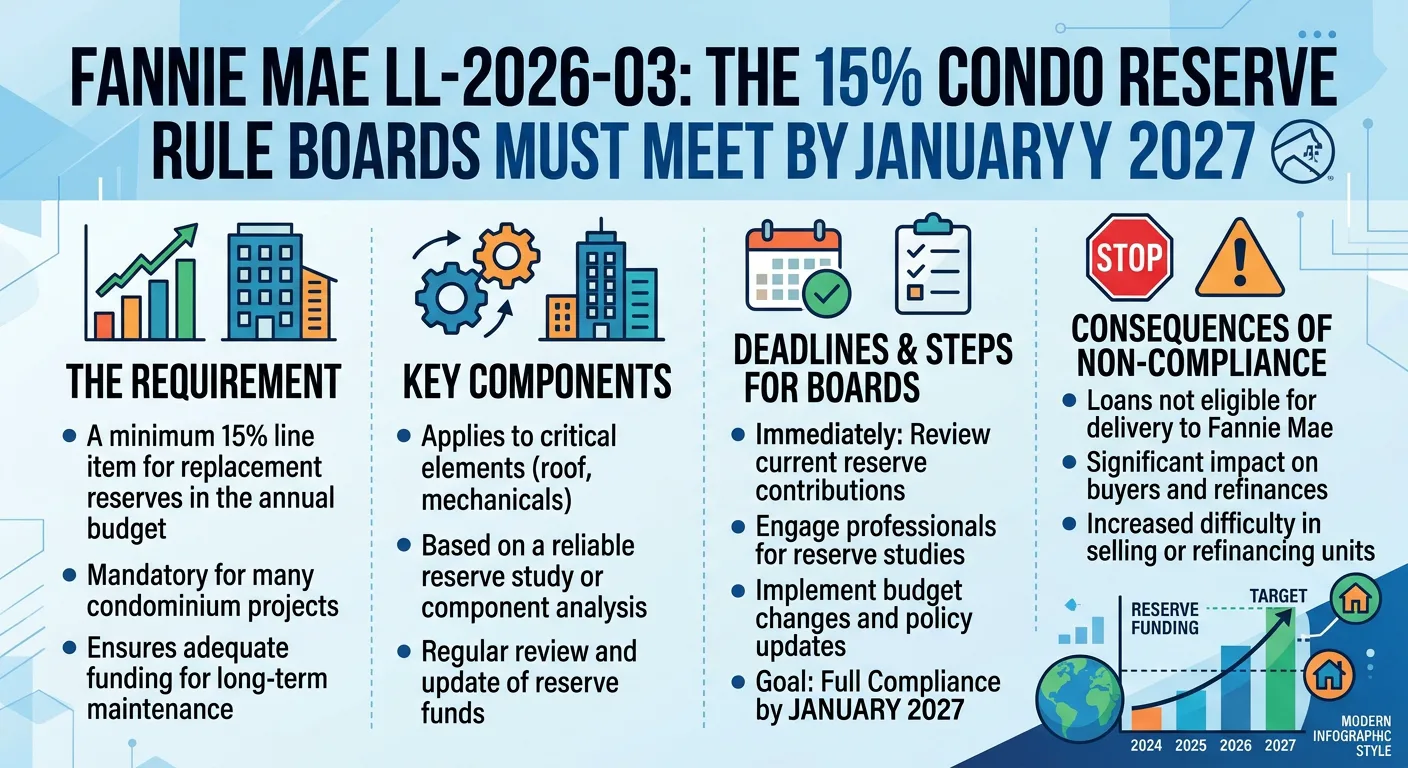
Why a lender rule matters to your board:
Fannie Mae doesn't regulate associations. It decides which condo loans it will buy. When a buyer or refinancing owner applies for a conventional loan, the lender reviews the **project**, not just the unit, to decide whether the loan is eligible for sale to Fannie Mae. A project that fails that review is often called **non-warrantable**.
Non-warrantable doesn't mean a unit can't be sold. It usually means fewer lenders, larger down payments, higher rates, or a cash-only buyer pool. That puts pressure on sale prices across the building. The reserve line in your budget is one of the things lenders check.
The 15% reserve rule:
What changes: Under Fannie Mae's Full Review process, a project's budget must allocate a minimum share of its annual budgeted assessment income to replacement reserves. That minimum has been 10%. Under LL-2026-03 it becomes 15% for loan applications dated on or after January 4, 2027.
How it's measured:
Budgeted annual reserve contribution ÷ budgeted annual assessment income
A few points boards often get wrong:
- It's a budget line, not a bank balance. The test looks at what your budget allocates to reserves each year. It isn't a percentage of the cash you already hold or of the property's value.
- Special assessments don't substitute. A special assessment to fund a project isn't treated as the budgeted reserve allocation.
- The trigger is the loan application date. It doesn't matter when the loan closes. An application dated January 4, 2027 or later is reviewed under the 15% standard.
Quick example: An association budgets $600,000 in annual assessments and $70,000 for reserves. That's 11.7%. It passes today but would fall short in January. Reaching 15% means a $90,000 reserve contribution, so the board needs to find $20,000 by raising dues, trimming operating costs, or using the reserve study route below.
The reserve study alternative, with stricter conditions:
Fannie Mae has long let a project that falls below the percentage threshold qualify with a reserve study instead. LL-2026-03 keeps that route but tightens it. According to industry summaries of the letter, effective August 3, 2026:
- The study must be current (completed or updated within the last three years) and prepared by an independent third party with reserve study expertise.
- The budget must fund the study's highest recommended reserve contribution. A board can't pick the cheapest funding plan in the study.
- A baseline funding plan, which aims only to keep the reserve balance above zero, **no longer qualifies.**
In practice, a reserve study is no longer a way around the 15% line for an underfunded association. It works only if the board actually adopts the study's most conservative funding level.
Other LL-2026-03 changes boards should know:
The reserve rule gets the attention, but the letter changes several other parts of project review. Industry summaries report the following:
Project review:
- Limited Review retired for established condo projects (effective August 3, 2026). Limited Review was the quicker review path that many established buildings relied on. With it gone, more loans in your building go through Full Review, which is where the reserve test applies.
- Waiver of project review expanded to projects with 10 or fewer units (previously much smaller projects only). For projects with 5 to 10 units, the waiver doesn't apply if the project is part of a master association or a multi-phase development.
- Investor concentration limit removed for established projects under Full Review. High rental percentages no longer disqualify an established building by themselves.
Master insurance:
- Inflation guard endorsement no longer required.
- Roofs may be covered on an actual cash value (ACV) basis, although the rest of the master policy must still meet the replacement cost requirement.
- Per-unit master policy deductible capped at $50,000 per occurrence, effective for loan applications on or after July 1, 2026.
Unit owner (HO-6) insurance:
- Reported limits include a maximum HO-6 deductible equal to the greater of 5% of coverage or $2,500, plus coverage sized to the interior restoration amount or the master policy's per-unit deductible.
Unchanged:
- Projects with unaddressed critical repairs remain ineligible, as do projects with significant deferred maintenance or unsafe conditions. A strong reserve budget doesn't overcome a building with known structural problems.
Who's most exposed:
- Older buildings that have kept dues low by holding reserve contributions near the old 10% floor.
- Associations that adopted a baseline or "minimum" funding plan from their reserve study.
- Associations with stale reserve studies (more than three years old).
- Established buildings that relied on Limited Review, where Full Review now applies.
- Florida condos already under milestone inspection and SIRS funding pressure, where the federal and state requirements now overlap.
Board checklist before January 4, 2027:
- Calculate your ratio now. Divide the 2027 budgeted reserve contribution by 2027 budgeted assessment income. If it's below 15%, flag it before the budget is adopted.
- Pull your reserve study. Check the date, who prepared it, and which funding plan the board adopted. If it's older than three years, order an update.
- Compare funding plans. If you plan to rely on the study instead of the 15% line, confirm the budget funds the **highest** recommended contribution, not a baseline plan.
- Model the dues impact. Show owners what reaching 15% costs per unit per month, and compare that with what non-warrantable status could do to sale prices.
- Review your master policy. Confirm your per-unit deductible is at or below $50,000 and that replacement cost coverage is documented.
- Update your lender questionnaire answers. Make sure your manager answers lender condo questionnaires with the new budget figures as soon as the budget is adopted.
- Clear any critical repairs** or document a funded plan to address them.
- Tell owners why.** A dues increase tied to keeping units financeable is easier to explain before the budget meeting than after.
FAQ
- What is Fannie Mae LL-2026-03?
It's a Fannie Mae Lender Letter issued March 18, 2026 that updates condo and co-op project standards and property insurance requirements. Its best-known change raises the minimum condo reserve allocation from 10% to 15% of budgeted assessment income.
- When does the 15% reserve rule take effect?
For loan applications dated on or after January 4, 2027.
- Is the 15% based on our reserve balance?
No. It's the share of your annual budgeted assessment income allocated to reserves in the budget, not the cash in your reserve account.
- Can a reserve study replace the 15% test?
Yes, if the study was completed or updated within the last three years by an independent qualified preparer and the budget funds the study's highest recommended contribution. Baseline funding plans don't qualify.
- Does Freddie Mac follow the same rule?
Fannie Mae says LL-2026-03 was implemented in alignment with Freddie Mac. Lenders and Freddie's own guide are the final word on Freddie-backed loans, so confirm with your lender.
- What happens if our association falls below 15%?
Loans in your building may not qualify for sale to Fannie Mae, which can limit buyers to non-conforming financing or cash. That tends to lengthen sale times and weigh on prices.
- Does this apply to HOAs with single-family homes?
The reserve test applies to condominium project review. Planned unit developments (PUDs) and detached condo units are generally handled under different, lighter review standards. Check with a lender for your specific community.
- Keep your reserve numbers ready for every lender
Lender questionnaires, reserve study dates, insurance deductibles, and budget ratios usually live in different places. That's how a building ends up non-warrantable without anyone noticing. My Front Yard keeps your association's budgets, reserve studies, insurance documents, and renewal dates in one place, so your board and manager can answer lender questions fast and spot a shortfall before buyers do. [See how it works →]
---
*Sources: Fannie Mae, "Lender Letter LL-2026-03: Updates to Project Standards & Property Insurance Requirements" (Mar. 18, 2026); Fannie Mae Capital Markets, "Fannie Mae Announces Updates to Single-Family Project Standards and Property Insurance Requirements" (Mar. 18, 2026); Fannie Mae Selling Guide B4-2.2 (Project Standards); Condo Approval Professionals, "Fannie Mae LL-2026-03: New Condo Rules Explained" (June 2026); HousingWire, "New York Condo Financing Overhaul Under Fannie Mae Full Review" (Sept. 2026); Reserve Study Group, "Fannie Mae Condo Reserve Requirements: The New 15% Rule" (Oct. 2026).*
*Informational only, not legal, lending, or financial advice. Confirm details with your association's attorney, reserve specialist, and a lender familiar with Fannie Mae project review.*