
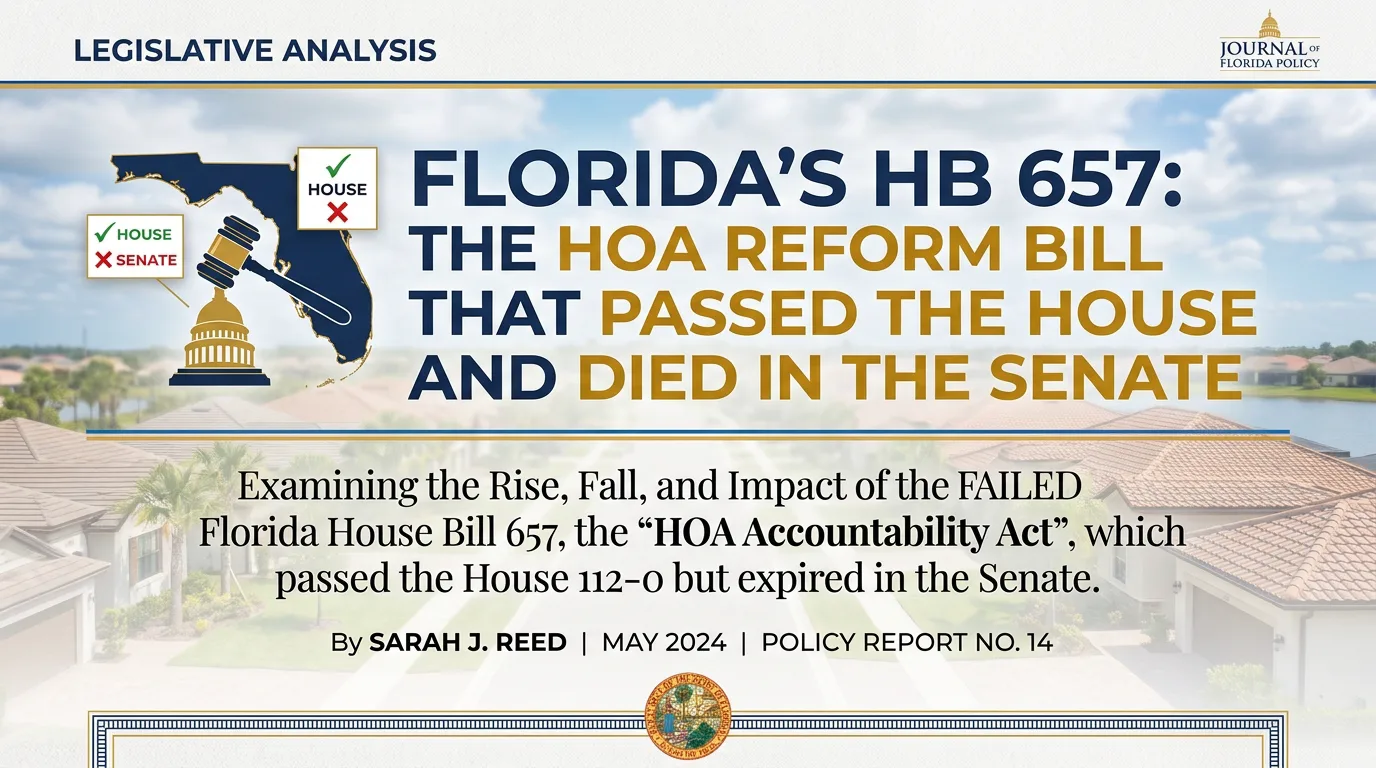
Florida's HB 657: The HOA Reform Bill That Passed the House and Died in the Senate
On March 5, 2026, the Florida House passed the most aggressive HOA bill the state has seen in years by a vote of 108 to 2. Its sponsor, Rep. Juan Carlos Porras (R-Miami), called homeowners' associations a "failed experiment." The bill would have let owners vote their HOA out of existence, created a new court program for association disputes, and eliminated presuit mediation. Eight days later it was dead. HB 657 was referred to the Senate Rules Committee, never heard, and died when the session ended on March 13. It had no Senate companion. So why write about a bill that failed? Because a 108-2 House vote is not a fringe idea, and Florida's HOA laws have a habit of returning in a new form the following year. If you sit on a board, manage communities, or own a home in an HOA, HB 657 is the clearest preview available of where Tallahassee may be heading in 2027.
MyFrontYard · October 9, 2026
The short version
| Proposal | What HB 657 would have done | Status today |
|---|---|---|
| HOA dissolution | Owners could petition, vote, and wind down their HOA | Not law |
| Community association courts | Optional circuit court programs for HOA and condo disputes, with four new judgeships | Not law |
| Presuit mediation | Eliminated for community associations | Still required under FS 720.311 |
| Conflicts of interest | New duty of loyalty; conflicted deals voidable | Existing FS 720.3033 disclosure rules still apply |
| "Kaufman" language | Every association votes on whether to follow future law changes | Not law |
| Roofing materials | HOAs couldn't mandate a specific material if the roof looks the same and meets code | Not law |
| Financial statements | GAAP-based statements with full bank statements and check images | Not law |
1. Owners could have dissolved their HOA
The headline provision was a new process, called the "Homeowners' Association Dissolution and Accountability Act," for owners to terminate their association. Here's how it worked in the version reported by the House Commerce Committee:
- Petition. An owner delivers a petition to the board. As filed in December 2025, the bill required signatures from 20% of voting interests. By the Commerce Committee stage, that threshold had risen to 50%.
- Meeting. The board must hold a members' meeting within 60 days, with notice that includes the proposed termination plan and how common areas and assets would be handled.
- Vote. The plan needs two-thirds of all voting interests, and no owner's vote could be suspended for the purpose.
- Cooling-off period. If the plan fails, a new one cannot be considered for 18 months.
- Court review. The approved plan goes to the circuit's community association court, which has 45 days to flag procedural problems. Silence means the plan is accepted.
- Wind-down. The board becomes the termination trustee by default, sells assets, settles debts, and distributes what's left to members equally or as the plan provides. Members wouldn't be personally liable for association debts beyond assessments already in place before the vote.
The bill also put teeth on the board's side of the process. Failing to call the meeting after a valid petition, using association money to campaign for or against termination, or hiding relevant financial records would have been unlawful, with civil penalties of up to $5,000 per violation, possible court-ordered removal, and personal liability for the petitioners' legal fees.
Once a dissolution was recorded, the HOA's covenants would have been deemed terminated and unenforceable. That's the part that drew the most concern from the industry. Many Florida communities depend on their HOA for stormwater systems, private roads, gates, and amenities that someone has to own, insure, and maintain after the association is gone.
2. A new court for HOA and condo disputes
HB 657 would have authorized each circuit court to create a voluntary community association court program for disputes under the Condominium, Cooperative, and HOA Acts. These courts could enforce statutory rights, order an association dissolved, appoint termination trustees, impose civil penalties, and award attorney's fees.
The bill funded four new circuit judgeships for the program: two in the Eleventh Circuit (Miami-Dade), one in the Thirteenth (Hillsborough), and one in the Seventeenth (Broward). The House's fiscal analysis estimated about $2.2 million in recurring state funding.
3. Presuit mediation would have disappeared
Today, many HOA disputes, including those over covenant enforcement and governing-document amendments, must go to presuit mediation under FS 720.311 before anyone can file suit. HB 657 would have removed that requirement.
This was one of the most contested pieces. Travis Moore of the Community Associations Institute, which opposed the bill, put it bluntly: "The minute you put the word court in front of something that means attorneys. It's going to cost more money." Supporters argued that mediation often just delays owners who have, in Porras's words, "absolutely no recourse for unnecessary fines, for liens."
4. Tougher conflict-of-interest rules
Current law already requires HOA directors to disclose certain conflicts in advance. HB 657 would have gone further by creating an express duty of loyalty to the association and its members. Any contract with, or payment to, a director, officer, committee member, or their immediate family would have been presumed a conflict. The interested person would have had to disclose in writing and sit out both the discussion and the vote, and any conflicted transaction would have been voidable unless a majority of all voting interests approved it after full disclosure. Governing documents couldn't waive any of it.
5. Every association would have voted on "Kaufman" language
Under a long-standing Florida rule from Kaufman v. Shere (1977), an association is generally governed by the statutes in effect when its documents were recorded unless those documents say otherwise. That's why some older communities aren't bound by newer protections.
HB 657 would have required every new association formed on or after July 1, 2026 to adopt language subjecting it to current and future law, and every existing association to hold a meeting by January 1, 2027 to vote on adding the same language. HOAs would have needed a majority of voting interests to approve it.
6. The smaller provisions worth knowing
Several lower-profile changes could easily resurface on their own:
- Financial statements would have had a statutory definition: GAAP-based, including a balance sheet, income and expense statement, budget comparison, and complete bank statements with images of every check.
- Law enforcement requests for records would have needed a response within five business days of a subpoena or written request, with a second-degree misdemeanor for directors or managers who willfully refuse.
- Roofing. HOAs couldn't have required a specific roofing material if the replacement looked substantially the same in shape and color and met Florida Building Code standards. A standalone Senate bill on the same topic (SB 924) also died.
- Condominium changes. Turnover inspections would have expanded to every building, and structural integrity reserve studies would have been limited to buildings with three or more habitable stories.
Why it died
HB 657 passed the House with near-unanimous support but arrived in the Senate with eight days left in session and no companion bill. It was referred to the Senate Rules Committee and never heard. The Senate's related bills didn't fare better: SB 1498 (community associations), SB 906 (an HOA ombudsman office), SB 908 (HOA fees), and SB 924 (roofing) all died in committee. HB 465 and SB 822, which would have required associations with $500,000 or more in annual revenue to hire a management firm, also died.
Florida bills do not carry over between sessions, so any of these ideas would need to be refiled.
What to watch in 2027
The 2027 regular session begins in March, with interim committee meetings and bill filing starting earlier. A few things are worth tracking:
- Whether a Senate sponsor emerges. HB 657's biggest weakness was the lack of a Senate companion. If the dissolution concept comes back with one, it becomes a far more serious bill.
- Whether the bill gets split. Dissolution and community association courts are the controversial pieces. Conflict-of-interest rules, financial statement definitions, and roofing protections could easily move as separate, less divisive bills.
- The mediation fight. Watch whether presuit mediation reform returns, and whether it's paired with cost controls that address the industry's attorney-fee concerns.
- New leadership. The November 2026 elections will reshape committee chairs and leadership in both chambers, which will matter more for HOA policy than any single bill's text.
Board checklist: what to do now
None of this is law, but the bill points directly at the practices lawmakers are scrutinizing. Boards that tighten these up now will be ready for whatever passes next.
- Document conflict-of-interest disclosures in writing and have conflicted directors leave the room for discussion and votes, even where current law doesn't strictly require it.
- Make sure financial statements are complete, including budget-to-actual comparisons and bank statements, and easy for owners to get.
- Review your fining and lien practices. Excessive fines and liens were the core complaint behind HB 657.
- Ask your attorney whether your documents include "as amended from time to time" language, so you know which version of Chapter 720 actually governs your community.
- Know your roofing rules and whether they would survive a material-neutral standard.
- Track the 2027 bills once filing opens, and talk to your legislators before committee hearings, not after.
FAQ
- Can Florida homeowners dissolve their HOA?
Not under the process HB 657 proposed, because the bill didn't become law. Dissolution today depends on your governing documents, Florida's Marketable Record Title Act, and corporate law, and it's rarely simple. Talk to an attorney before attempting it.
- What was Florida HB 657?
HB 657 was a 2026 House bill, sponsored by Rep. Juan Carlos Porras, that would have let HOA members vote to dissolve their association, created community association court programs, eliminated presuit mediation, and added new conflict-of-interest and financial reporting rules. It passed the House 108-2 on March 5, 2026, and died in the Senate Rules Committee on March 13, 2026.
- Is presuit mediation still required for Florida HOA disputes?
Yes. FS 720.311 still requires presuit mediation for many HOA disputes, including those over covenant enforcement and amendments to governing documents. HB 657 would have removed it, but the bill didn't pass.
- Will the HOA dissolution bill come back in 2027?
It's possible. Florida bills don't carry over, so it would have to be refiled. The House vote shows strong support, but it would need a Senate sponsor and committee hearings to move further than it did in 2026.
- Did any HOA bills pass in Florida in 2026?
Based on end-of-session reports, none of the major Chapter 720 reform bills, including HB 657, SB 1498, SB 906, and HB 465/SB 822, became law in 2026. Earlier reforms, such as 2024's HB 1203, remain in effect.
- Get ahead of the next reform
Every recent Florida HOA bill has pushed in the same direction: more transparency, clearer financial records, and less room for conflicts of interest. My Front Yard helps Florida boards keep official records organized, track owner requests against statutory deadlines, and give owners easy access to the documents lawmakers keep asking about. [See how it works →]
---
*Sources: Florida Senate, [CS/CS/CS/CS/HB 657 (2026) bill history](https://www.flsenate.gov/Session/Bill/2026/657); Florida House Commerce Committee, [Staff Analysis of HB 657](https://www.flsenate.gov/Session/Bill/2026/657/Analyses/h0657g.COM.PDF) (Mar. 3, 2026); Florida Senate, [SB 906 (2026)](https://www.flsenate.gov/Session/Bill/2026/906); Central Florida Public Media, ["Florida House passes bill to rein in homeowners associations"](https://www.cfpublic.org/2026-03-06/florida-house-passes-bill-rein-in-homeowners-associations) (Mar. 6, 2026); WPLG Local 10, ["Florida House passes sweeping HOA reform bill, but Senate fate looks bleak"](https://www.local10.com/news/politics/2026/03/05/florida-house-passes-sweeping-hoa-reform-bill-but-senate-fate-looks-bleak/) (Mar. 5, 2026); ClickOrlando, ["New proposal in Florida could abolish HOAs across the state"](https://www.clickorlando.com/news/florida/2026/01/24/new-proposal-in-florida-could-abolish-hoas-across-the-state-heres-how/) (Jan. 24, 2026); Campbell Property Management, ["2026 Florida End of Legislative Session Report"](https://www.campbellpropertymanagement.com/blog/2026-florida-end-of-legislative-session-report); Florida Statutes §§ 720.311, 720.3033.*
*Informational only, not legal advice. HB 657 did not become law, and nothing in this article describes current Florida requirements unless it says so. Confirm the current version of Chapter 720 with your association's attorney before relying on anything here.*