
Tennessee Condo Records: The 2008 Condo Act vs. the Horizontal Property Act
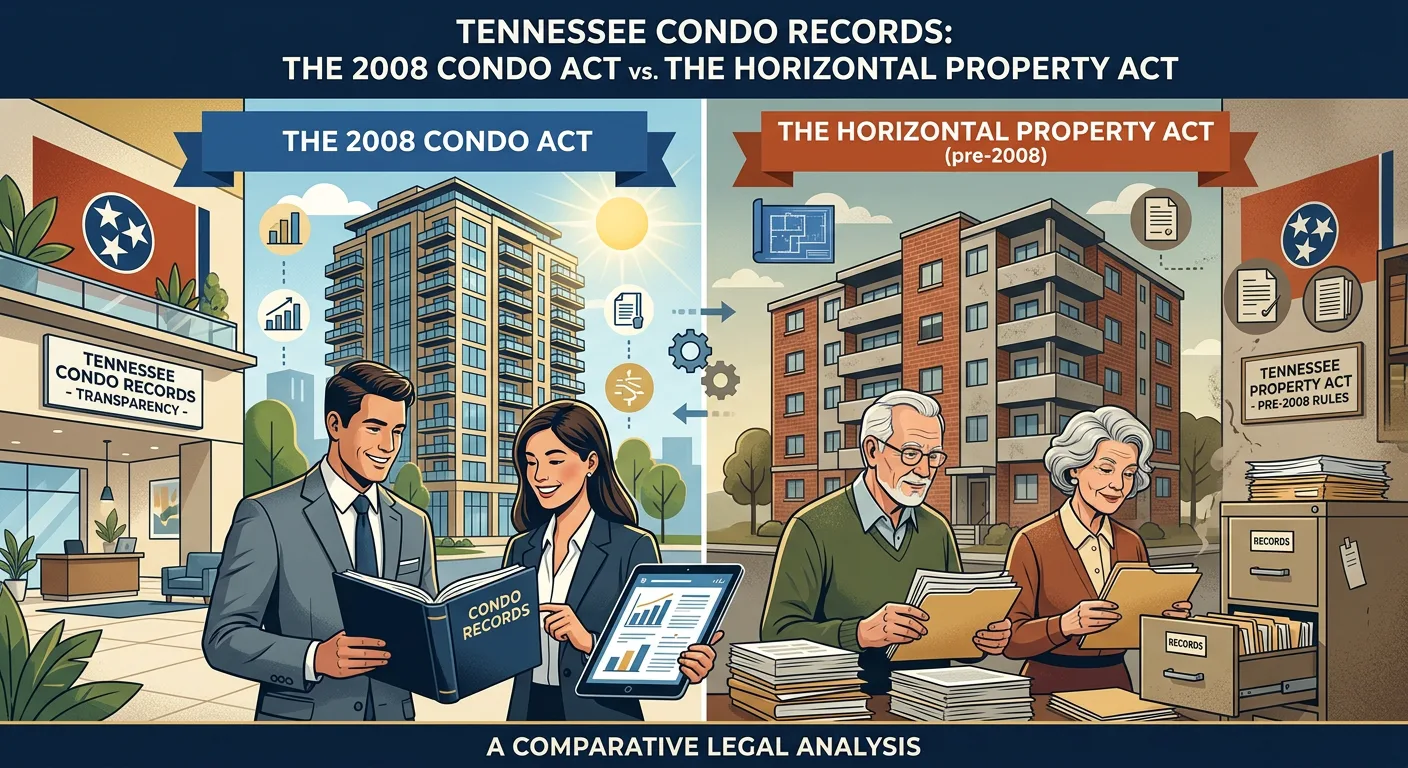
Tennessee has two condominium statutes, and which one your association follows starts with a single date: January 1, 2009. Condos created before then grew up under the Horizontal Property Act (Tenn. Code Ann. Title 66, Chapter 27, Part 1). Condos created after it fall under the Condominium Act of 2008 (Parts 2 through 5 of the same chapter). For records, the split matters, though not as cleanly as most summaries suggest. The 2008 Act deliberately reaches back and applies its records rule to older condos too. Here's how the two laws fit together, and what a board should actually do.
MyFrontYard · October 20, 2026
Step 1: Figure out which act governs your condo
Section 66-27-202 sets the rules:
- Created after January 1, 2009: the Condominium Act of 2008 applies in full. The Horizontal Property Act does not.
- Created before January 1, 2009: the Horizontal Property Act still governs. But Section 66-27-202(a) lists specific 2008 Act sections that also apply to these older condos, for events after January 1, 2009. The records section, 66-27-417, is on that list, along with all of Part 5 (resale disclosures).
- Older condos that opted in: under Section 66-27-202(c), a pre-2009 condo can elect to be governed by the 2008 Act in its entirety by amending and restating its master deed, bylaws, and plats.
The fastest way to tell is to check the recording date of your master deed (or declaration) at the county register of deeds, and whether it was later amended and restated under the 2008 Act.
The Horizontal Property Act rule (Sec. 66-27-113):
Paraphrasing Section 66-27-113, the administrator or board of a Horizontal Property Act condo must keep a book with a detailed, chronological account of receipts and expenditures affecting the building, including the maintenance and repair costs of the common elements.
That book, and the vouchers supporting its entries, must be available for examination by all co-owners at convenient hours on working days, set and announced for general knowledge.
Three things stand out:
- It's financial only. The section covers the receipts-and-expenditures book and its backup, not minutes, contracts, or correspondence.
- It expects a schedule. "Set and announced" hours suggests the board should publish when the books can be reviewed, rather than handle each request ad hoc.
- Vouchers count. Owners can look at the invoices and receipts behind the ledger, not just a summary.
The 2008 Condo Act rule (Sec. 66-27-417)
Section 66-27-417 is short. The association must keep financial records detailed enough to comply with Sections 66-27-502 and 66-27-503 (the resale disclosure rules). And "all financial and other records" must be reasonably available for examination by:
- any unit owner;
- the holder of any mortgage or deed of trust on a unit; and
- their authorized agents.
That's broader than the Horizontal Property Act in two ways. It covers other records, not just the books, and it extends the right to lenders and agents, not just owners.
Why older condos get both:
Because Section 66-27-417 is one of the provisions Section 66-27-202(a) applies to pre-2009 condos, an older association effectively has both duties: keep the Section 66-27-113 receipts book with vouchers, and make all financial and other records reasonably available under Section 66-27-417.
One limit matters here. Except for one unrelated provision, the 2008 Act sections that reach older condos **do not invalidate or supersede** the existing master deed, bylaws, or plats. If your pre-2009 bylaws have their own records procedures, they still count. Read them alongside the statute rather than assuming one replaces the other.
Side by side:
| Horizontal Property Act (Sec. 66-27-113) | Condominium Act of 2008 (Sec. 66-27-417) |
|---|---|
| Applies to: condos created before January 1, 2009 | Applies to: condos created after January 1, 2009, and pre-2009 condos for events after that date |
| Records covered: the receipts-and-expenditures book and its supporting vouchers | Records covered: all financial and other records |
| Who can inspect: co-owners | Who can inspect: unit owners, mortgage holders, and their authorized agents |
| When: at convenient hours on working days, set and announced for general knowledge | When: "reasonably available" |
| Response deadline: none stated | Response deadline: none stated |
| Copy fees: not addressed | Copy fees: not addressed |
The bottom line: a post-2009 condo follows Section 66-27-417. A pre-2009 condo follows both, so it needs the detailed receipts book and has to open its broader records to owners, lenders, and agents.
What neither statute says:
Neither condo statute sets a response deadline, a written-request format, a proper-purpose test, or a copy-fee rule. That's where many disputes start.
Two other sources often fill the gap:
- Your governing documents. Bylaws frequently set notice periods, locations, and fees.
- The Tennessee Nonprofit Corporation Act. If the association is incorporated as a nonprofit, Tenn. Code Ann. § 48-66-102 generally gives members inspection rights on five business days' written demand, requires a good-faith, proper purpose for accounting records and the membership list, and allows a reasonable copy charge limited to cost. Confirm with counsel how it interacts with the condo statutes for your association.
Separately, if the request is tied to a sale, Section 66-27-502 has a firm clock: the association must provide the Section 66-27-503 resale information within 10 business days of receiving a request from an owner, purchaser, or lender, and may charge a reasonable fee. That applies to pre-2009 condos too.
Board checklist:
- Confirm your act. Pull the master deed recording date and check for any amended-and-restated documents that opted into the 2008 Act.
- Keep a chronological receipts-and-expenditures ledger with supporting vouchers, especially if you're a pre-2009 condo.
- Keep financial records detailed enough to produce resale disclosures under Sections 66-27-502 and -503.
- Adopt a written records policy covering how to request, a response timeframe, inspection location, and copy costs.
- Publish inspection hours so the "set and announced" standard is easy to meet.
- Treat lender and agent requests as valid under Section 66-27-417.
- Check whether you're a nonprofit corporation and align your policy with Section 48-66-102 if so.
- Calendar the 10-business-day resale deadline for every disclosure request.
FAQ
- Does the Tennessee Condominium Act of 2008 apply to older condos?
Partly. Under Tenn. Code Ann. § 66-27-202(a), listed sections, including the records rule in § 66-27-417 and the resale disclosure rules in Part 5, apply to pre-2009 condos for events after January 1, 2009. Pre-2009 condos can also opt in fully.
- What records can a Tennessee condo owner inspect?
Under § 66-27-417, all financial and other records must be reasonably available to unit owners, mortgage holders, and their agents. Under the Horizontal Property Act, § 66-27-113 specifically covers the receipts-and-expenditures book and supporting vouchers.
- How long does a Tennessee condo association have to respond to a records request?
The condo statutes don't set a deadline. Check your bylaws, and if the association is a nonprofit corporation, the Nonprofit Corporation Act's five-business-day demand rule may apply. Resale disclosures have a separate 10-business-day deadline.
- Can a Tennessee condo association charge for copies?
The condo statutes don't address copy fees. Governing documents or, for nonprofit corporations, § 48-66-102 may allow a reasonable charge limited to cost. Resale information may carry a reasonable fee under § 66-27-502.
- How do I know if my condo is under the Horizontal Property Act?
Check when the master deed or declaration was recorded. If it was before January 1, 2009, and it hasn't been amended and restated to opt into the 2008 Act, the Horizontal Property Act still governs, with the listed 2008 Act sections layered on top.
- Make "reasonably available" easy
When records live in one volunteer's garage, "reasonably available" becomes an argument. My Front Yard keeps governing documents, financial records, and owner requests organized in one place, so boards can answer records and resale requests quickly, whichever act applies. [See how it works →]
---
*Sources: Tenn. Code Ann. §§ 66-27-113, 66-27-202, 66-27-417, 66-27-502, 66-27-503 (2025), via Justia and the Tennessee Code; Acts 2008, ch. 766; Tenn. Code Ann. § 48-66-102.*
*Informational only, not legal advice. Talk to your association's attorney before adopting or changing a records policy.*