
Texas HOA Fines: The Notice-and-Hearing Requirements Under Sec. 209.006-.007
Most Texas HOA fine disputes don't turn on whether the owner actually broke the rule. They turn on whether the board followed the process before charging the fine. Chapter 209 of the Texas Property Code, the Residential Property Owners Protection Act, sets that process out step by step, and the step boards skip most often is the simplest one: giving the owner the full 30-day window to request a hearing before the fine moves forward. Here's what Sections 209.006, 209.0061, and 209.007 require, where boards tend to slip, and a checklist for getting it right.
MyFrontYard · October 19, 2026
Who this applies to:
Chapter 209 covers property owners' associations in residential subdivisions where membership is mandatory. Texas condominiums are generally governed by the Property Code's condominium chapters (Chapter 82 for most), which have their own notice-and-hearing rules. If you're unsure which statute governs your community, confirm with counsel first.
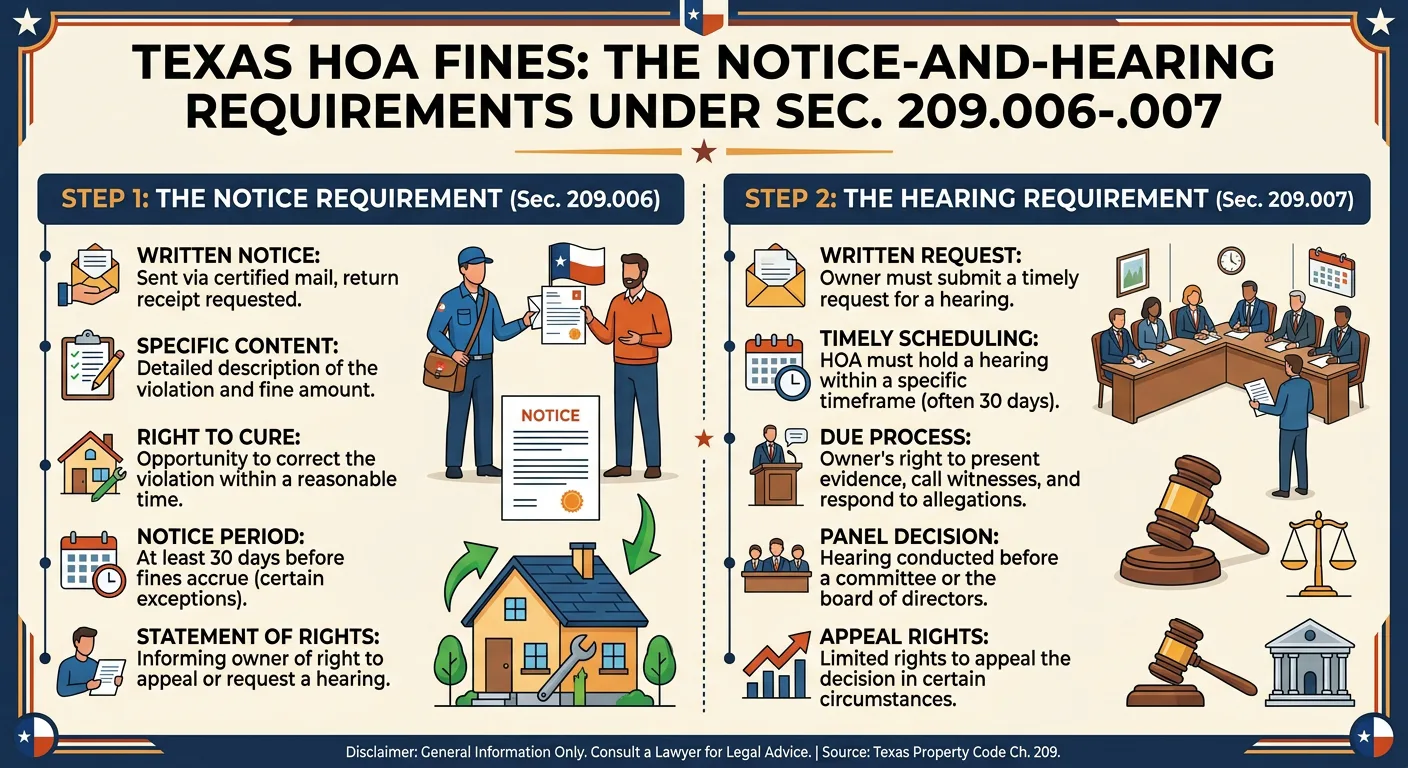
Step 1: A written notice, sent the right way (Sec. 209.006)
Paraphrasing Section 209.006, before an association can levy a fine for a violation of the restrictions, bylaws, or rules, it must send the owner written notice by certified mail. The same notice requirement applies before the association suspends an owner's use of a common area, charges an owner for property damage, reports a delinquency to a credit bureau, or files most lawsuits against an owner.
The notice must:
- Describe the violation (or property damage) that's the basis for the fine, and state any amount the owner owes.
- Tell the owner they're entitled to a reasonable period to cure the violation and avoid the fine, if the violation is curable and doesn't threaten public health or safety.
- State the cure deadline, a specific date by which the owner must fix the problem.
- Tell the owner they may request a hearing under Section 209.007 on or before the 30th day after the notice was mailed.
- Tell the owner they may have special rights under federal law, including the Servicemembers Civil Relief Act, if they're on active military duty.
The statute also says the notice goes by verified mail to the owner's last known address in the association's records. Use certified mail, use the address on file, and keep the receipt.
Step 2: The cure period, and why it matters
If the owner cures the violation before the cure period ends, no fine may be assessed. That's the plain language of Section 209.006(e), and it's the core protection in the statute.
The cure period must be reasonable. The statute doesn't set a number of days, so think about what the fix actually takes. Ten days to move a trailer may be fine. Ten days to repaint a house may not be.
Section 209.006 also sorts violations into two buckets:
- Curable violations include parking violations, maintenance violations, failing to build according to approved plans, and ongoing noise like a barking dog.
- Incurable violations are ones that already happened and aren't continuing, such as shooting fireworks, a one-time noise violation, property damage (including removing or altering landscaping), holding a garage sale or other event the governing documents prohibit, and acts that threaten health or safety. Simply not doing it again doesn't count as a cure.
For incurable violations, there's no cure period to offer, but the notice requirement still applies before a fine.
The repeat-violation exception. If the owner already received a Section 209.006 notice for the same violation within the preceding six months, and had the chance to exercise their rights, the association doesn't have to send a new notice before fining again. Track the date of every notice so you know when this exception applies and when it has lapsed.
Step 3: The hearing (Sec. 209.007)
The owner may submit a written request for a hearing before the board to discuss and verify facts and resolve the matter. Section 209.007 ties that right to violations where the owner is entitled to an opportunity to cure, but the Section 209.006 notice still has to describe the hearing right. Many associations offer a hearing on any fine rather than argue later about which bucket a violation fell into.
Once a request comes in, the deadlines are tight:
- Hold the hearing within 30 days after the board receives the request.
- Give the owner at least 10 days' notice of the hearing's date, time, and place.
- At least 10 days before the hearing, give the owner a packet with all documents, photos, and communications the association plans to introduce. If the packet is late, the owner gets an automatic 15-day postponement.
- Either side may request a postponement, which must be granted for up to 10 days. Further postponements require agreement.
- The association presents first (a board member or designated representative), then the owner or their representative.
- Either party may audio-record the hearing.
Owners and associations can also use alternative dispute resolution.
When notice and hearing don't apply. Sections 209.006 and 209.007 don't apply when the association files suit for a temporary restraining order or temporary injunction, or a suit that includes foreclosure. A board can also temporarily suspend common-area use, without the usual process, when a violation in a common area posed a significant and immediate risk of harm, until the board reaches a final decision under the hearing procedures.
The gap boards fall into:
The common failure looks like this: a notice goes out with a 10-day cure deadline, the owner doesn't cure, and the fine posts to the ledger on day 11. Then late fees stack on top, and maybe a collection letter follows.
The problem is that the owner was told they had 30 days from mailing to request a hearing. Escalating before that window closes, or before a requested hearing actually happens, invites a dispute over whether the fine was properly levied. Since S.B. 1588 (2021), owners can bring Chapter 209 claims in justice court, so a procedural mistake is cheaper and easier for an owner to challenge than it used to be.
The fix is mostly calendar discipline. Don't post the fine until the cure deadline has passed, the 30-day hearing window has closed with no request, or the board has held the hearing and decided the matter.
Step 4: Have a published fine policy (Sec. 209.0061)
Since January 1, 2024 (H.B. 614), any association whose governing documents authorize fines must have a board-adopted enforcement policy that includes:
- the general categories of restrictive covenants the association may fine for;
- a schedule of fines for each category; and
- information about the hearing process under Section 209.007.
The policy may reserve the board's discretion to set fines case by case. It must be posted on an association website owners can access, or sent to owners at least once a year, and posted on any public website the association or its manager maintains. If your association fines without an adopted, distributed policy, fix that first.
Board checklist
- Adopt and publish a fine policy with categories, a fine schedule, and hearing information, per Section 209.0061.
- Build a notice template that includes every required element: violation description, amount owed, cure right, cure date, 30-day hearing right, and military-service notice.
- Send by certified mail to the address in the association's records, and save the receipt.
- Set reasonable cure periods by violation type, and write them into the policy.
- Calendar three dates for every notice: the cure deadline, day 30 for a hearing request, and the six-month repeat-violation window.
- Hold the fine until the cure deadline passes and the hearing window closes or the hearing is held.
- Prepare the hearing packet early, and deliver it at least 10 days before the hearing.
- Record the board's decision in writing, and send it to the owner.
- Review your management agreement so the manager's enforcement steps match the statute.
FAQ
- Does a Texas HOA have to give notice before fining a homeowner?
Yes. Under Tex. Prop. Code § 209.006, the association must send written notice by certified mail before levying a fine, describing the violation and the owner's rights, unless the owner received a notice for the same violation within the preceding six months.
- How long does a Texas homeowner have to request a hearing?
The owner may request a hearing on or before the 30th day after the notice was mailed. The board must then hold the hearing within 30 days of receiving the request.
- Can a Texas HOA fine me if I fix the violation?
Not if you cure it within the cure period stated in the notice. Section 209.006(e) says no fine may be assessed if the owner cures before the cure period expires.
- What is an uncurable violation in Texas?
One that already occurred and isn't ongoing, such as shooting fireworks, a one-time noise violation, removing landscaping, or holding a prohibited event. There's no cure period for these, but notice is still required before a fine.
- Does my Texas HOA need a written fine schedule?
If its governing documents allow fines, yes. Since January 1, 2024, Section 209.0061 requires a board-adopted policy with fine categories, a fine schedule, and hearing information, made available to owners.
- What has to happen at the hearing?
The owner gets at least 10 days' notice and a packet of the association's evidence at least 10 days in advance. The association presents first, then the owner, and either side may record the hearing.
- Keep the clock on your side
Most fine disputes in Texas are timing problems: a fine posted before the cure date, or before the hearing window closed. My Front Yard helps boards keep notices, governing documents, and compliance records organized and track upcoming deadlines, so the 30-day clock doesn't depend on a volunteer's memory. [See how it works →]
---
*Sources: Tex. Prop. Code §§ 209.006, 209.0061, 209.007 (2025), via Texas Legislature Online and Justia; Acts 2021, 87th Leg., R.S., ch. 951 (S.B. 1588); Acts 2023, 88th Leg., R.S., ch. 666 (H.B. 614).*
*Informational only, not legal advice. Talk to your association's attorney before adopting or changing an enforcement policy.*