
Arizona HOA Assessment Laws: What Boards and Owners Need to Know in 2026
Assessments are the money that keeps an Arizona HOA running, and state law has a lot to say about them: how much they can rise, when a payment is late, what a late fee can be, how payments are applied, and when an association can foreclose. Two things make this worth a fresh look in 2026. First, Arizona's rules are split across two separate statutes, and they don't treat assessments the same way. Second, SB 1246, effective September 12, 2026, changed the foreclosure rules for condominiums and for large special assessments in every kind of association. Here's the full picture, paraphrased from the statutes.
MyFront Yard · October 12, 2026
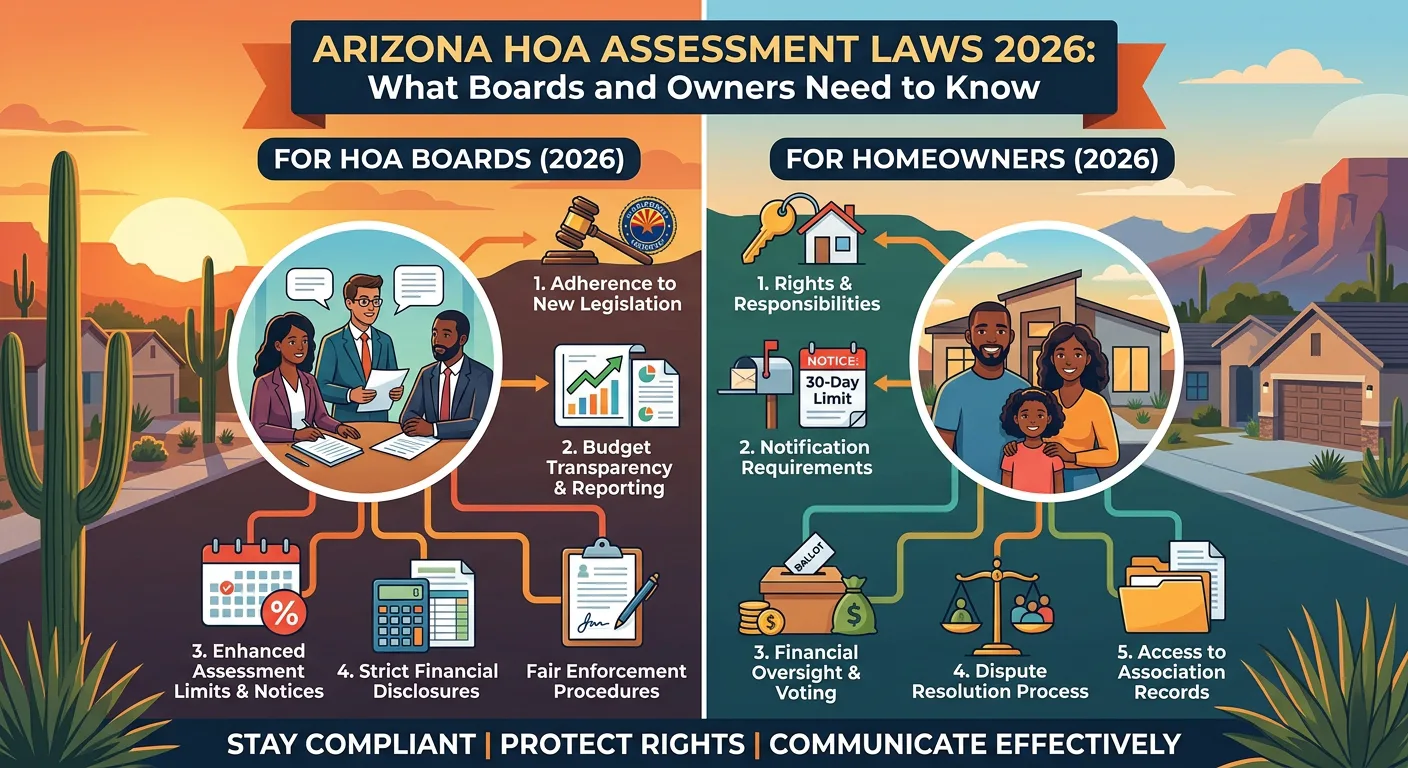
Two statutes, two rulebooks:
Arizona regulates community associations under two acts in Title 33:
- The Planned Community Act (A.R.S. § 33-1801 and following) covers most single-family HOAs.
- The Condominium Act (A.R.S. § 33-1201 and following) covers condominium associations.
The planned-community statute is much more specific about assessments. The condo statute leaves more to the declaration. Know which one your association falls under before relying on any number below.
How much can assessments go up?
Planned communities: 20% per year. Under A.R.S. § 33-1803(A), an association can't raise the regular annual assessment more than 20% over the prior fiscal year without approval from a majority of the members. If your governing documents set a lower cap, the lower cap controls.
Condominiums: no statutory cap. The Condominium Act doesn't set a percentage limit. Under § 33-1255, assessments are made at least annually from the association's adopted budget, so any limit comes from the declaration or bylaws.
For condos, § 33-1255 also says some costs must be charged only to the units that benefit from them: limited common elements, expenses that benefit fewer than all units, and costs caused by one owner's misconduct.
When is a payment late, and what can the HOA charge?
For planned communities, § 33-1803 sets clear rules:
- A payment is late once it's 15 or more days past due, unless the documents allow longer.
- The late charge can't exceed $15 or 10% of the unpaid assessment, whichever is greater.
- The association can charge a late fee only after notifying the owner that the assessment is overdue, or will be after a certain date.
Condominiums can also charge late fees after notice under § 33-1242, but the statute doesn't set a dollar cap. Interest on past-due condo assessments is set by the board, subject to the condominium documents.
Fines are a separate category. In both kinds of association, the board can impose reasonable penalties for rule violations only after **notice and an opportunity to be heard**. For planned communities, late charges on unpaid fines are capped the same way as assessment late fees, regardless of what the documents say.
Where an owner's payment goes first:
When an owner in a planned community is behind, § 33-1807(K) sets the order payments are applied, unless the owner directs otherwise and regardless of what the governing documents say:
1. Unpaid assessments
2. Assessments that are due but not yet delinquent
3. Late charges (if the declaration authorizes them)
4. Reasonable collection fees and costs
5. Court-awarded attorney fees and costs related to the assessments
6. Everything else: other fees, fines, penalties, and interest
This is designed so that late fees and collection costs can't pile up while the underlying assessment stays unpaid.
The assessment lien:
In both planned communities and condos, an unpaid assessment becomes a lien on the owner's property the moment it's due (§ 33-1807 and § 33-1256). For a planned community:
- Recording the declaration is enough to perfect the lien. No separate filing is needed.
- The lien generally comes ahead of other liens, except a recorded first mortgage or deed of trust, liens recorded before the declaration, and property-tax liens.
- The lien is extinguished unless the association starts enforcement within six years after the full amount comes due.
- Fines are not part of the assessment lien. They become a lien only after a court judgment, and that judgment lien can't be foreclosed.
Before the attorneys get involved:
For planned communities, § 33-1807 adds several collection safeguards:
- 30-day notice. At least 30 days before an attorney or outside collection agency starts collecting, the association must send a delinquency notice by **certified mail, return receipt requested, in bold or all caps, with contact information.
- Statements of account. Associations must provide account statements showing the balance and ledger history (communities with fewer than 50 lots and no outside manager are exempt).
- Payoff statements in 10 days. On written request, the association must provide the unpaid lien amount within 10 days. If it fails to give one to an escrow agent, the lien for assessments then due is extinguished.
- Convenience fees. Fees for card or electronic payments can't exceed roughly what the payment processor charges.
Foreclosure: what SB 1246 changed:
Arizona associations can foreclose an assessment lien, but only after the delinquency is large or old enough.
Planned communities were already limited to foreclosing once an owner was delinquent for 18 months or $10,000, whichever comes first, measured on the filing date.
SB 1246 (2026 Ariz. Laws Ch. 162) made three changes:
- Condos now match planned communities. The condo threshold in § 33-1256 rises from one year or $1,200 to 18 months or $10,000, whichever comes first.
- Large special assessments get only the time test. For any special assessment with an initial value of $10,000 or more, only the 18-month test applies, in both condos and planned communities. A big roof or repaving assessment can't trigger foreclosure just because it crosses $10,000 on day one.
- No selling the debt. Associations may not transfer ownership or control of assessment-lien debt or member/owner expense debt to a third party.
Both statutes also require the board to make reasonable efforts to contact the owner and offer a reasonable payment plan before filing for foreclosure.
Disclosing assessments at resale:
When a home in a planned community sells, § 33-1806 requires the association to give the buyer a disclosure that includes:
- The regular assessment amount and payment schedule
- Remaining installments on any approved special assessment
- Any special assessment approved by the board but not yet levied, or submitted for member approval within the past four months
- Any unpaid assessment lien or judgment lien
- mThe current operating budget and the most recent income and expense statement
Fees for that disclosure and related transfer services are capped at $400 total, plus up to $100 for a 72-hour rush and up to $50 for an update 30 or more days later. An association that overcharges faces a civil penalty of up to $1,200. The Condominium Act has its own parallel resale-disclosure section.
Board checklist:
- Confirm which statute applies to your association: Planned Community Act or Condominium Act.
- Check next year's budget against the 20% cap (planned communities) and any lower cap in your documents.
- Audit your late-fee policy for the 15-day grace period, the $15/10% cap, and the required overdue notice.
- Confirm your management company applies payments in the § 33-1807(K) order.
- Update your foreclosure policy for the 18-month/$10,000 threshold, the 18-month-only rule for special assessments of $10,000 or more, and the payment-plan offer. Condo boards: your old one-year/$1,200 trigger no longer applies.
- Check collection-agency contracts for any assignment or sale of association debt, which is now prohibited.
- Review your resale-disclosure fees against the $400/$100/$50 caps.
FAQ:
- How much can an Arizona HOA raise assessments?
In a planned community, no more than 20% over the prior year's regular assessment without majority member approval, or less if the governing documents say so. Arizona's Condominium Act has no statutory cap.
- What is the maximum late fee an Arizona HOA can charge?
For planned communities, the greater of $15 or 10% of the unpaid assessment, and only after the association gives notice that the payment is overdue. Payments become late after 15 days.
- When can an Arizona HOA foreclose for unpaid assessments?
Only after the owner is delinquent for 18 months or owes $10,000 or more, whichever comes first. For special assessments of $10,000 or more, only the 18-month test applies. SB 1246 extended this threshold to condominiums as of September 12, 2026.
- Can an Arizona HOA foreclose over unpaid fines?
No. Fines aren't part of the assessment lien. They become a lien only after a court judgment, and that lien can't be foreclosed.
- Can an Arizona HOA sell an owner's debt to a collection company?
Not anymore. SB 1246 prohibits associations from transferring ownership or control of assessment-lien or owner-expense debt.
- Keep your assessment rules in one place
Between the 20% cap, the late-fee limits, the payment order, and the new foreclosure thresholds, Arizona gives boards a lot to track. My Front Yard helps boards keep governing documents, budgets, and compliance deadlines organized, so a statutory change like SB 1246 doesn't get lost between management handoffs. [See how it works →]
---
Sources: A.R.S. §§ 33-1242, 33-1255, 33-1256, 33-1803, 33-1806, 33-1807; SB 1246, 2026 Ariz. Laws Ch. 162 (approved June 19, 2026); Arizona House of Representatives, SB 1246 summary (as signed); Carpenter, Hazlewood, Delgado & Bolen, "SB 1246" legislative update.
*Informational only, not legal advice. Talk to your association's attorney before changing your budget, collection policy, or governing documents.