Blog

HOA & property management insights

Practical guidance for boards, managers, and community operators evaluating modern HOA software.

Arizona HOA Assessment Laws: What Boards and Owners Need to Know in 2026
Arizona HOACompliance

Arizona HOA Assessment Laws: What Boards and Owners Need to Know in 2026

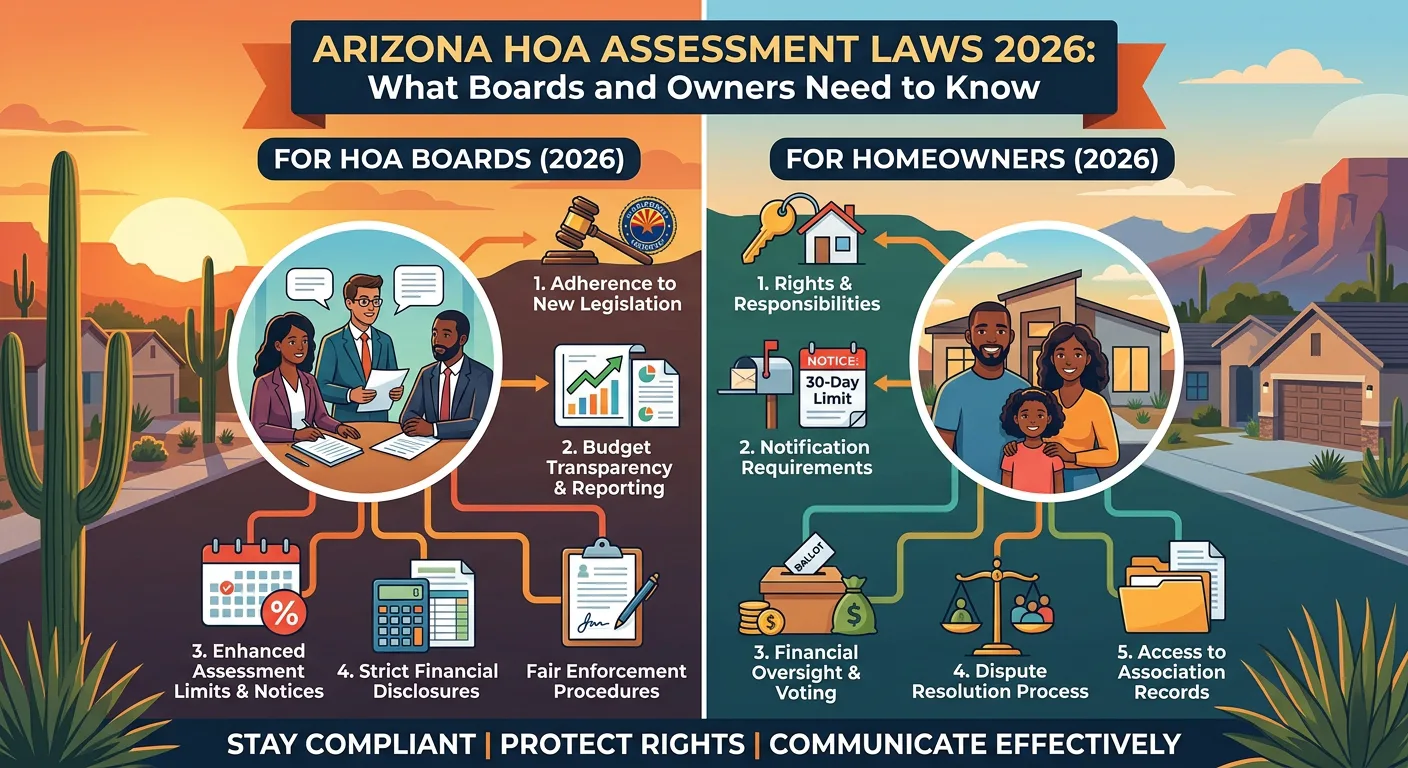
Assessments are the money that keeps an Arizona HOA running, and state law has a lot to say about them: how much they can rise, when a payment is late, what a late fee can be, how payments are applied, and when an association can foreclose. Two things make this worth a fresh look in 2026. First, Arizona's rules are split across two separate statutes, and they don't treat assessments the same way. Second, SB 1246, effective September 12, 2026, changed the foreclosure rules for condominiums and for large special assessments in every kind of association. Here's the full picture, paraphrased from the statutes.

MyFront Yard · October 12, 2026
Why Arizona HOA Boards Can No Longer Vote in Executive Session: HB 1290 Explained
Arizona HOACompliance

Why Arizona HOA Boards Can No Longer Vote in Executive Session: HB 1290 Explained

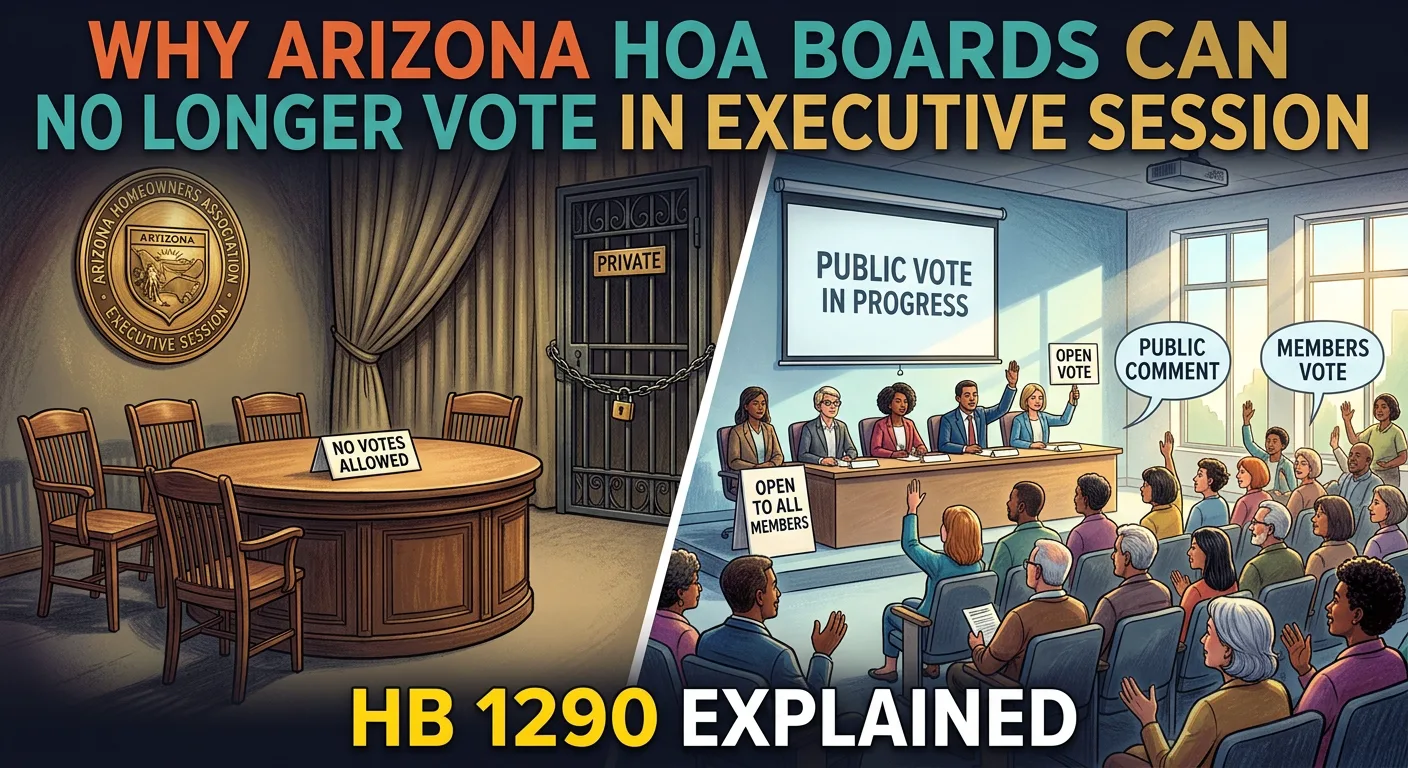
For years, a lot of Arizona HOA boards ran meetings the same way: go into executive session, talk through the delinquent account or the violation appeal or the vendor dispute, take a vote, and come back out. As of September 12, 2026, a planned community board can't do that anymore. Senate Bill 1290, signed by Governor Katie Hobbs on June 22, 2026, adds two words to Arizona's open-meeting statute for planned communities: a closed session is now limited to consideration "without action." Boards can still discuss sensitive matters behind closed doors. Every vote has to happen in an open meeting. Here's what changed, why it isn't the only reason this matters, and what your board should change before its next meeting.

MyFrontYard · October 12, 2026

Florida's New Citizens Insurance Clearinghouse: What HOA & Condo Boards Must Know
Florida HOACompliance

Florida's New Citizens Insurance Clearinghouse: What HOA & Condo Boards Must Know

If your condominium or homeowners association insures its buildings with Citizens Property Insurance Corporation, your 2027 renewal will work differently. SB 1028, signed by Governor DeSantis on June 16, 2026 (Chapter 2026-150), requires Citizens to send commercial policies, including association master policies, through new commercial clearinghouses before it will write or renew them. Citizens must have them running by January 1, 2027. The goal is to move more commercial risks back into the private market. For a board, that means your Citizens renewal may come with a private offer you're expected to take, possibly from a surplus lines carrier you've never heard of, on a shorter timeline than you're used to. Here's how it works and what to do about it while you're still building next year's budget.

MyFrontYard · October 8, 2026

Florida SIRS Deadline: What HOA Boards Must Do By December 31, 2026
Florida HOACompliance

Florida SIRS Deadline: What Boards Must Do By December 31, 2026

Most Florida condo boards remember December 31, 2025 as "the SIRS deadline." For a large group of associations, though, that wasn't the real deadline. HB 913 (2025) let associations that also owed a milestone inspection do both at once, and gave them until December 31, 2026. That year-end date is now about 12 weeks away, and the statute says plainly that it won't move: "In no event may the structural integrity reserve study be completed after December 31, 2026." The 2026 legislative session didn't change it either. The omnibus condo bill (HB 657) died in the Senate in March, so the rules boards are working under still come from HB 1021 (2024) and HB 913 (2025).

MyFrontYard · October 6, 2026

Colorado's New 30 Year Reserve Study Mandate: HB26-1099
Colorado HOACompliance

Colorado's New 30-Year Reserve Study Mandate: What HB26-1099 Requires

Reserve funding is the line item that keeps Colorado boards up at night. Underfund it and the roof, the paving, or the pool eventually turns into a special assessment. Owners are rarely ready for that. Much of the problem starts on day one. A developer sets the first budget while it still controls the HOA. That budget is often built to keep monthly dues low and sell units, not to pay for a roof 20 years out. By the time owners take over the board, the gap is already there. HB26-1099, titled Protect Financial Condition of Homeowners Associations, goes after that gap. Governor Polis signed it on April 13, 2026, and it took effect August 12, 2026. Here's what it requires, who it applies to, and what it doesn't do.

MyFrontYard · October 5, 2026

Florida's HB 1203
Florida HOACompliance

HB 1203 Explained: Criminal Liability for Records Mismanagement

Most coverage of Florida's 2024 HOA reform law opens with fines, architectural review, and garbage cans. Those changes are real, but they bury the part that changed the stakes for board members: HB 1203 made certain records failures a crime. Before July 1, 2024, a Florida HOA that stonewalled a records request mostly risked a civil damages claim and attorney's fees. Under HB 1203 (Chapter 2024-221, Laws of Florida), a director or community association manager can now face a criminal charge for the same conduct, provided the statute's intent elements are met. This article walks through each new offense, what it actually takes to trigger one, and what your board should be doing about it.

MyFrontYard · October 1, 2026

Which States Actually Regulate HOAs? A 5-State Comparison
Compliance

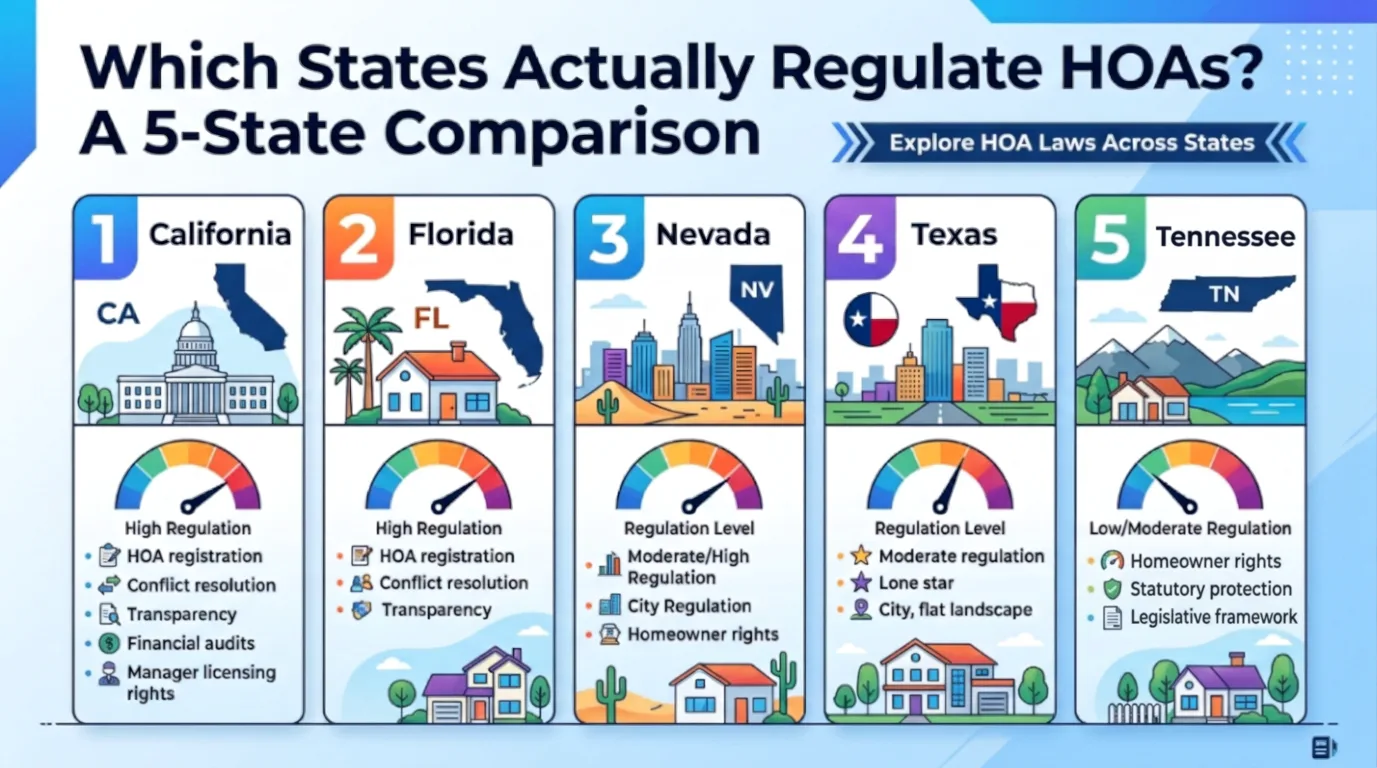
Which States Actually Regulate HOA's? A 5-State Comparison

Most homeowners assume that somewhere in state government, there's an office that oversees HOAs the way a banking regulator oversees banks, or a licensing board oversees contractors. Across Florida, Texas, Nevada, California, and Tennessee, that assumption is mostly wrong — and the exceptions are more interesting than the rule. Of these five states, only one has an agency that can investigate a board and discipline it. One more has a regulator, but its authority stops at the condominium property line. The other three route essentially everything through civil court, with no government office to call first.

MyFrontYard · September 22, 2026

Florida HOA Image
Florida HOACompliance

Florida's HOA Website and Portal Rules Are Now the Baseline: A 2026 Compliance Refresher

What boards and managers should do this quarter: - Confirm your website/portal obligation for your association's type and size, and verify you're actually meeting it — not just that a page exists. - Audit your records. Make sure the required documents are present, current, and access-controlled, with personal/sensitive data protected. - Tighten your fine and notice process so enforcement holds up to scrutiny. - Get new directors their required education on time, and keep proof.

HOA GURU · June 25, 2026