
Why Arizona HOA Boards Can No Longer Vote in Executive Session: HB 1290 Explained
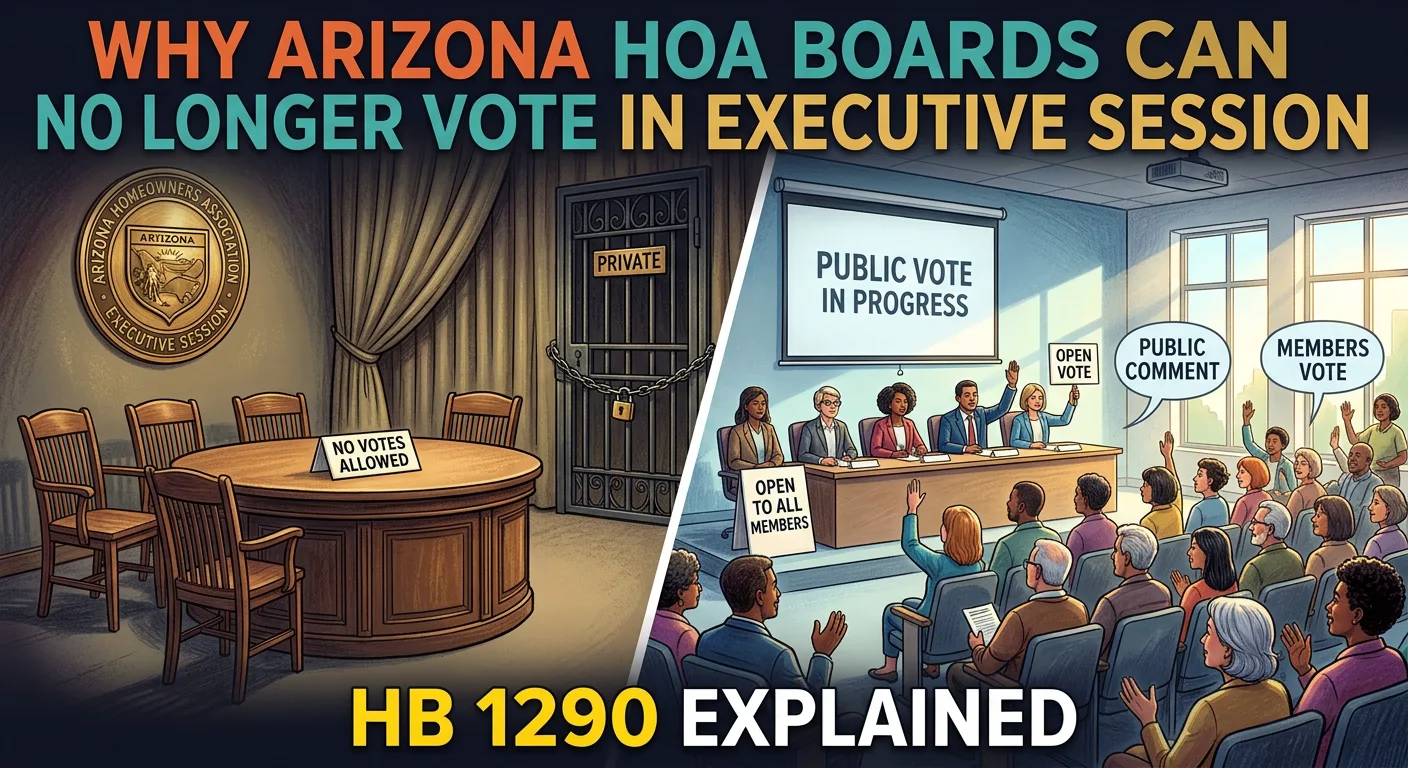
For years, a lot of Arizona HOA boards ran meetings the same way: go into executive session, talk through the delinquent account or the violation appeal or the vendor dispute, take a vote, and come back out. As of September 12, 2026, a planned community board can't do that anymore. Senate Bill 1290, signed by Governor Katie Hobbs on June 22, 2026, adds two words to Arizona's open-meeting statute for planned communities: a closed session is now limited to consideration "without action." Boards can still discuss sensitive matters behind closed doors. Every vote has to happen in an open meeting. Here's what changed, why it isn't the only reason this matters, and what your board should change before its next meeting.
MyFrontYard · October 12, 2026
What SB 1290 actually changes
The law amends A.R.S. § 33-1804(A), the section of the Planned Community Act that governs open board meetings. Arizona already let boards close part of a meeting for five reasons only:
1. Legal advice from the association's attorney
2. Pending or contemplated litigation
3. Personal, health, or financial information about an individual member, employee, or contractor
4. Job performance, compensation, health records, or specific complaints about an individual employee or contractor
5. A member's appeal of a violation or penalty, unless the member asks for an open session
SB 1290 doesn't remove any of those categories. It changes what a board can do once the doors are closed. A closed portion of a meeting is now limited to "consideration without action" of those topics. Deliberation is fine. Motions, votes, and final decisions are not.
Two things the bill does not do:
- It doesn't apply to condominiums. SB 1290 amends only § 33-1804, the planned-community statute. (Condo boards should keep reading anyway; see the court case below.)
- It doesn't eliminate executive session. Boards still have a legitimate place to hear from counsel or talk about an owner's finances in private.
The court got there first
SB 1290 didn't come out of nowhere. On April 28, 2026, the Arizona Court of Appeals decided AZNH Revocable Trust v. Sunland Springs Village Homeowners Association (No. 1 CA-CV 25-0424), and reached essentially the same conclusion.
The Sunland Springs board had used closed sessions to approve a roughly $917,000 budget item, give its community manager up to $7,000 in discretionary spending authority, decide 13 age-requirement waivers, and authorize two foreclosures. The court held that "consideration" in § 33-1804 means deliberation, not voting, so votes and formal actions belong in open meetings. It also held that:
- Closed-session agendas need real descriptions. Citing the statutory paragraph alone ("Executive session under A.R.S. § 33-1804(A)(2)") doesn't give members enough information. Boards can still withhold personally identifying and privileged details.
- Closed minutes don't authorize closed votes. The fact that § 33-1805 lets an association withhold executive-session minutes doesn't mean the board can act there.
- Boards can delegate the agenda call. A board may delegate the job of identifying which items qualify for closed session, for example to its president, but that delegation should be done properly.
Several Arizona community-association firms read the decision's reasoning as reaching condominium boards under the parallel condo statute, A.R.S. § 33-1248, as well. So even though SB 1290 is planned-community only, condo boards are wise to follow the same practice. The case is reportedly the subject of a petition for review at the Arizona Supreme Court, so watch for further developments, but SB 1290 now puts the core rule for planned communities in statute regardless.
What this looks like in a real meeting
The practical shift is a two-step sequence for anything sensitive:
- Discuss in executive session. Hear the attorney's advice, review the delinquent account, listen to the owner's appeal.
- Act in the open meeting. Return to open session, state a motion that identifies the action, and vote where members can see it.
The obvious worry is privacy: how do you vote on a collection matter or a violation appeal in public without airing an owner's business? The answer most practitioners are giving is to identify the matter without identifying the person, using a lot number, account number, or case ID. A motion like "Move to approve the payment plan for Account #7447 as discussed in executive session" keeps the vote public and the details private.
Expect a few knock-on effects:
- Longer open agendas. Every action item, including ones discussed in closed session, needs its own line on the open agenda.
- Owner comment on more items. Arizona's open-meeting rules give members a chance to speak before a board votes on an agenda item, which now includes items that used to be decided privately.
- Executive-session minutes get thinner. Since no decisions happen there, those minutes record discussion only. Decisions show up in the open-meeting minutes.
Board checklist
- Stop voting in executive session, effective now. SB 1290 has been in effect since September 12, 2026.
- Rewrite your agenda templates. Executive-session agendas should describe each topic specifically (e.g., "Owner violation appeal, Lot 112"), not just cite the statute.
- Add a matching action item to the open agenda for every closed-session topic that may need a decision.
- Adopt a standard motion format that references matters by lot, account, or case number, not by owner name or confidential detail.
- Decide who prepares closed-session agendas, and approve that delegation in an open meeting so it's in the minutes.
- Look back at recent closed-session decisions. Ask counsel whether anything decided privately should be ratified in an open meeting.
- Brief your management company. Collection letters, foreclosure authorizations, and vendor terminations may now need an open-meeting vote before they go out.
- Condo boards: confirm with counsel how AZNH applies to you under § 33-1248, even though SB 1290 itself doesn't.
FAQ
- When did Arizona's SB 1290 take effect?
September 12, 2026, Arizona's general effective date for 2026 legislation. The governor signed it June 22, 2026.
- Can Arizona HOA boards still hold executive sessions?
Yes. Boards can still close part of a meeting to discuss the five topics listed in A.R.S. § 33-1804(A), such as legal advice, litigation, and individual owners' financial information. They just can't take action or vote while closed.
- Does SB 1290 apply to Arizona condominium associations?
Not directly. SB 1290 amends only the Planned Community Act. But the Court of Appeals' AZNH v. Sunland Springs Village decision is widely read as applying the same no-vote principle to condo boards under § 33-1248.
- How do boards vote on confidential matters in an open meeting?
Discuss the details in executive session, then return to open session and vote on a motion that identifies the matter by lot, account, or case number rather than by name or sensitive detail.
- What happens to decisions a board already made in executive session?
That's a question for your association's attorney. Some boards are choosing to ratify recent closed-session decisions in an open meeting to reduce the risk of a challenge.
- Keep your meetings, and your records, in the open
SB 1290 turns a long-standing habit into a compliance issue. My Front Yard helps boards keep agendas, minutes, and governing documents organized in one place, so every action item has a clear paper trail from executive-session discussion to open-meeting vote. [See how it works →]
---
*Sources: Arizona Legislature, SB 1290 House fact sheet (as passed House); Carpenter, Hazlewood, Delgado & Bolen, "SB 1290" legislative update; Mulcahy Law Firm, "No Board Action in Closed Session" and "Immediate Impact: New Arizona Case Changes HOA/Condo Board Meeting Requirements"; AZNH Revocable Trust v. Sunland Springs Village HOA, No. 1 CA-CV 25-0424 (Ariz. Ct. App. Apr. 28, 2026); Associated Asset Management, "Arizona HOA Executive Session Rules: What Boards Must Know."*
*Informational only, not legal advice. Talk to your association's attorney before changing your meeting procedures or agenda templates.*